The Engineer Who Drowned Building Timaru's First Harbour
The tragic story of James Melville Balfour and the experimental concrete breakwater that survived only months—but changed everything
Timaru, New Zealand • December 1869 – August 1870
On the morning of December 19, 1869, Colonial Marine Engineer James Melville Balfour stood on Timaru's shingle beach inspecting his experimental concrete breakwater. He told the Board of Works: "The first block had been put down, and for an experiment it had been very successful."
That afternoon, he drowned attempting to board a ship offshore—killed by the very surf conditions his breakwater was designed to study.
He was 38 years old. His experimental structure survived only a few months longer before a storm "carried it away entirely." Yet this double failure—of life and structure—proved essential to understanding how to tame one of New Zealand's most dangerous coastlines.
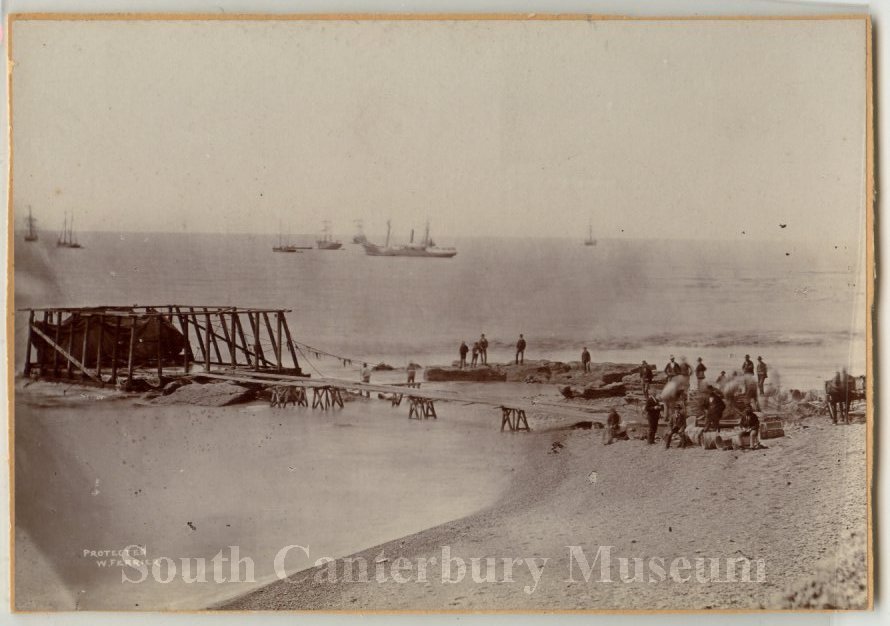
The Problem: A Killer Coast
In the 1860s, Timaru was a death trap. Ships anchored offshore in an open roadstead—no harbour, no protection. Passengers and cargo transferred through surfboats in conditions that could turn deadly in minutes.
1865–1890
constantly moving
shingle drift rate
The coast had a unique challenge: powerful southerly swells drove beach material northward at extraordinary rates—up to one mile per day even in calm weather. Any structure that blocked this "shingle conveyor belt" risked catastrophic consequences.
Why Was This So Hard?
Imagine building a concrete wall on a beach where:
- Waves constantly pound the construction site
- You can only work at low tide
- Thousands of tons of gravel are grinding past every day
- The ocean is trying to destroy everything you build
That was Timaru in 1869.
The Engineer: James Melville Balfour
James Melville Balfour was a Scottish lighthouse engineer who arrived in New Zealand in 1863. Trained by the famous Stevenson family (his brother-in-law was the father of author Robert Louis Stevenson), he brought cutting-edge engineering knowledge to the young colony.
Appointed Colonial Marine Engineer in 1866, Balfour took a scientific approach unusual for the time. Rather than just building structures and hoping they'd work, he conducted experiments:
- He placed lead-weighted blocks on the beach to track how fast shingle moved
- He measured wave patterns and tidal forces
- He designed a small-scale experiment to test theories before committing to expensive, large-scale works
His approach was revolutionary: build to learn, accept that failure generates valuable data, use modest experiments to inform major projects.
The Scientific Approach: Balfour's 1865 Survey
Four years before building his experimental breakwater, Balfour conducted a comprehensive scientific survey of Timaru's roadstead. These original documents reveal the meticulous research that shaped his experiment.
📜 Historical Documents from October 1865
The following images are scans of Balfour's original survey report and planning map submitted to the Otago Provincial Government in October 1865. These are primary historical sources showing his scientific methodology.
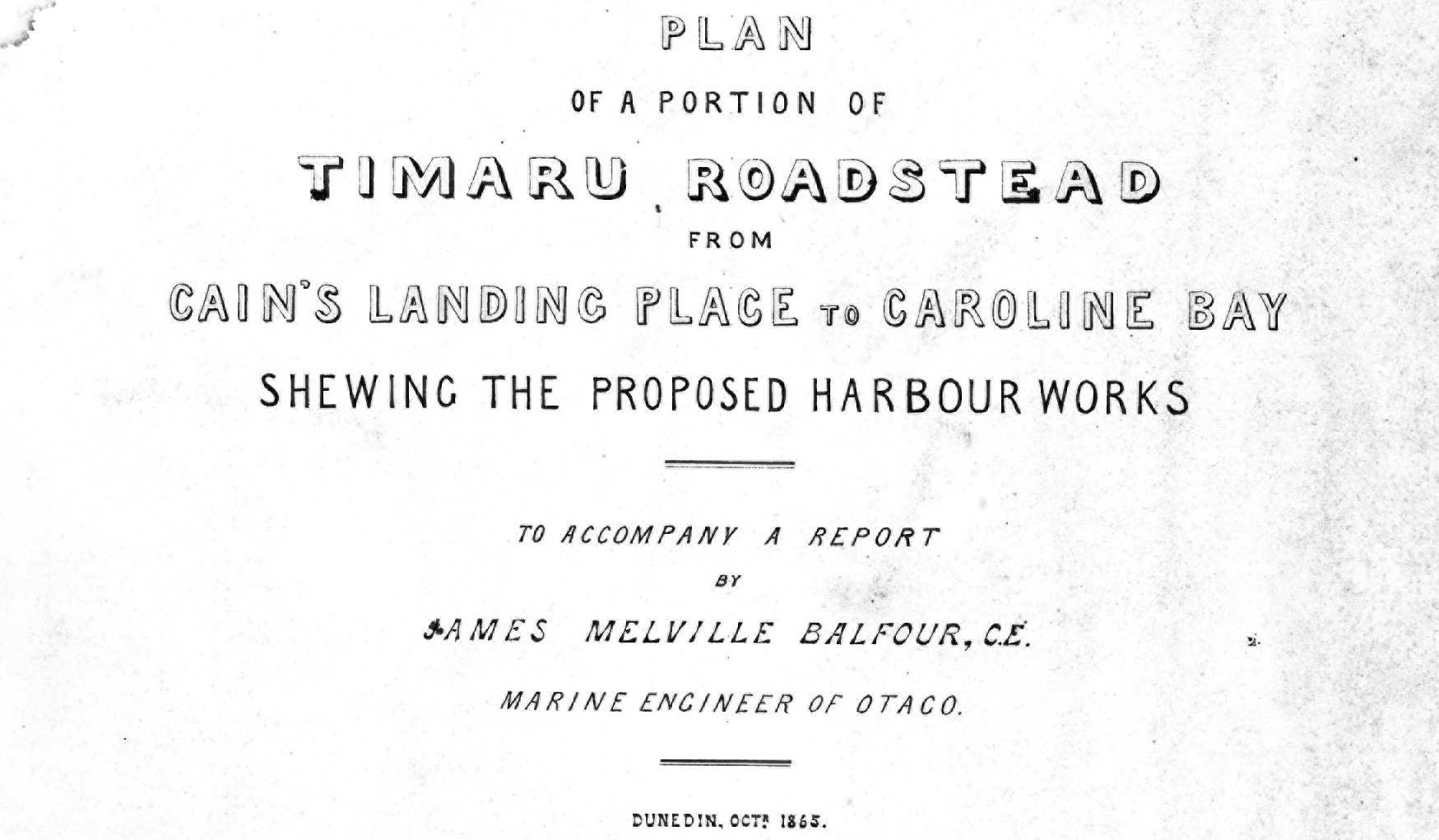
"Plan of a Portion of Timaru Roadstead from Cain's Landing Place to Caroline Bay, Shewing the Proposed Harbour Works to accompany a Report by James Melville Balfour, C.E., Marine Engineer of Otago. Dunedin, Octr 1865."
Note his title: "Marine Engineer of Otago" — this was before he became Colonial Marine Engineer in 1866.
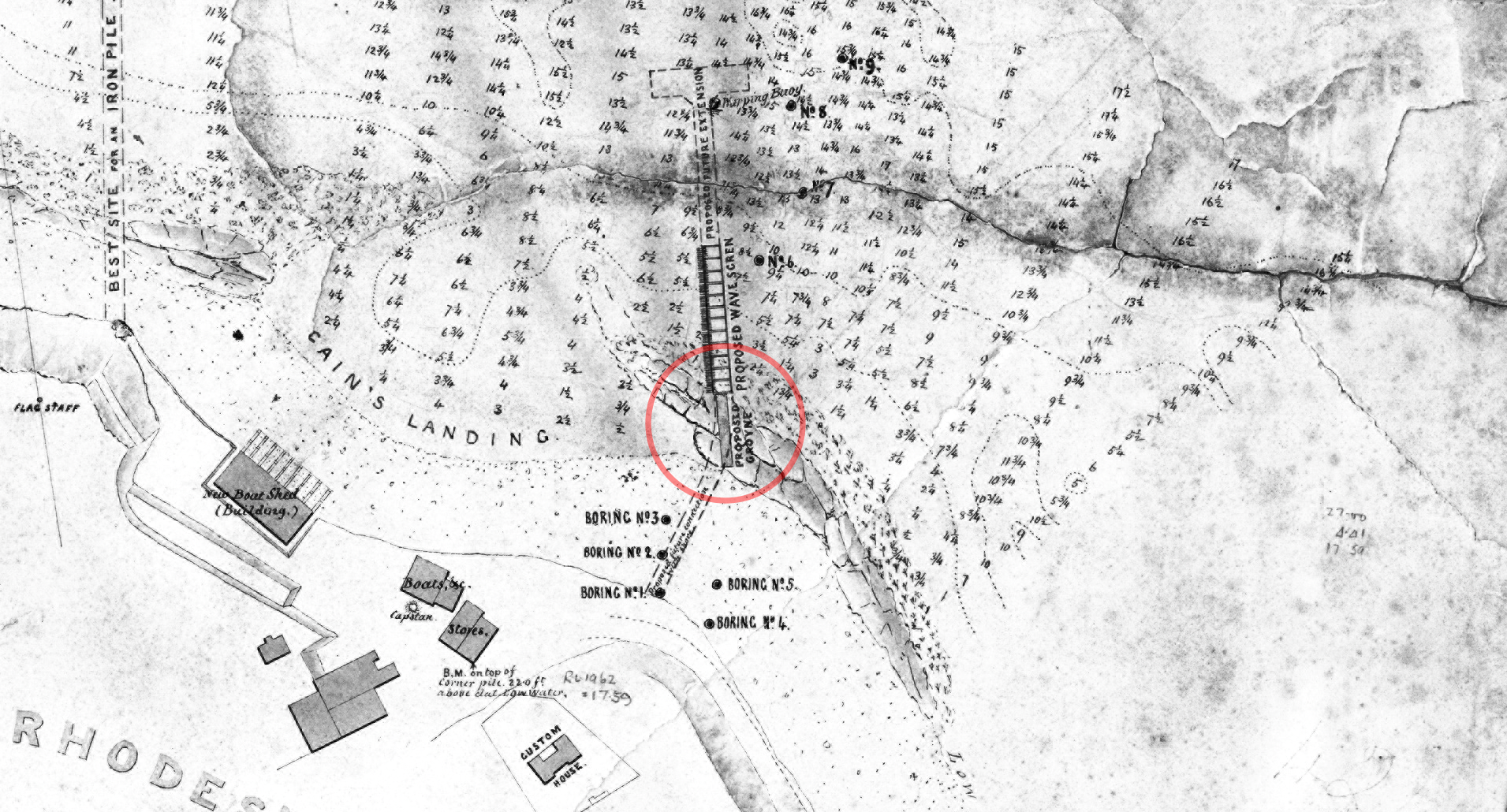
What This Map Shows:
- Red circle: The reef area where Balfour proposed building his experimental structure (this is where the 1869-70 breakwater was later constructed)
- Boring locations No. 1-5: Where Balfour drilled test holes into the seabed to determine bottom composition and rock depth
- Depth soundings: Numbers across the entire map showing water depths at low tide — critical data for understanding wave behavior and construction challenges
- Cain's Landing Place: The existing landing site (labeled on map) — the dangerous spot where passengers and cargo transferred from ships through surfboats
- Shore buildings: New Boat Shed, boarding houses, Captain Stokes' property — showing the maritime infrastructure already established
- Reef configuration: The dotted patterns show shallow water and exposed rock — this basalt reef became Balfour's construction platform
This map documents the site four years before construction began. Balfour's systematic survey provided the foundation for his experimental design.
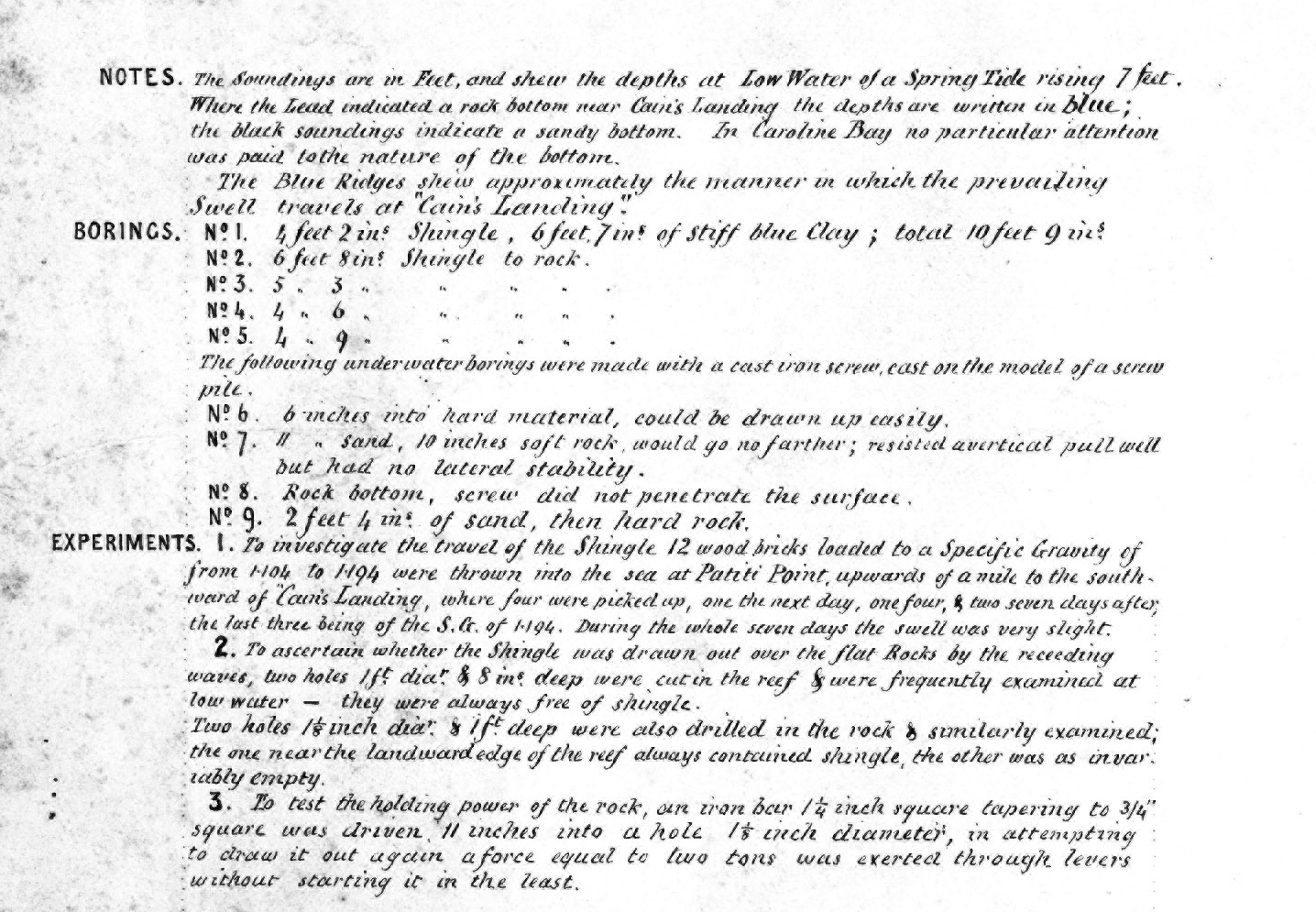
This document reveals Balfour's scientific methodology in detail:
NOTES Section:
- Soundings in feet at low water of a spring tide rising 7 feet
- Color coding: Red soundings = rock bottom, Black soundings = sandy bottom
- Blue ridges: Show "the manner in which the prevailing Swell travels or 'Cains Landing'" — visualizing wave patterns
- In Caroline Bay: "no particular attention was paid to the nature of the bottom" (his focus was on the landing area)
BORINGS (Test Holes 1-9):
Balfour drilled nine test holes to determine what lay beneath the surface:
- No. 1: 4 ft 2 in shingle, 6 ft 1 in stiff blue clay (total depth 10 ft 9 in)
- No. 2: 6 ft 8 in shingle to rock
- No. 3-5: Varying depths of shingle to rock (4-9 feet)
- No. 6-7: Attempted borings using cast iron screw — difficult conditions, limited success
- No. 8: Rock bottom — screw could not penetrate
- No. 9: 2 ft 4 in sand, then hard rock
These borings revealed that solid basalt reef lay beneath a relatively thin layer of mobile shingle — critical information for construction planning.
EXPERIMENTS Section — The Key Discovery:
Experiment 1: Tracking Shingle Movement
"To investigate the travel of the Shingle, 12 wood bricks loaded to a Specific Gravity of from 140lb to 149lb were thrown into the sea at Patiti Point, upwards of a mile to the southward of Cains Landing."
- Timeline: Thrown in on November 19, 1864 (written as "11/9b to 1/19b" in old notation)
- Results: Four were picked up the next day, one four days later, two seven days after
- Final three: Located south of the reef on January 19, 1865
- Conclusion: During the whole seven days, "the swell was very slight" — yet the blocks still traveled approximately one mile in seven days
Experiment 2: Testing if Shingle Moves Over Flat Rocks
"To ascertain whether the Shingle was drawn out over the flat Rocks by the receding waves, two holes 1 ft diameter & 8 inches deep were cut in the reef & were frequently examined at low water — they were always free of shingle."
"Two holes 14 inch diameter & 11½ deep were also drilled in the rock & similarly examined; the one near the landward edge of the reef always contained shingle, the other was as invariably empty."
Discovery: Shingle doesn't get pulled back over flat rock by receding waves — it moves along the beach surface, accumulating at certain points.
Experiment 3: Testing Rock Holding Power
"To test the holding power of the rock: an iron bar 1¾ inch square tapering to ¾ inch square was driven 11 inches into a hole 1¾ inches diameter. In attempting to draw it out again a force equal to two tons was exerted through levers without starting it in the least."
Conclusion: The basalt reef was strong enough to anchor heavy structures — this directly informed his later use of iron "lewises" to hold formwork during concrete construction.
Why This Matters: Science Before Construction
These 1865 documents reveal that Balfour's 1869-70 experimental breakwater wasn't a guess — it was the culmination of four years of systematic scientific investigation:
- ✓ He measured shingle movement rates precisely (lead-weighted blocks)
- ✓ He understood bottom composition (9 borings)
- ✓ He tested rock holding power (iron bar experiment)
- ✓ He mapped wave patterns and depth soundings comprehensively
- ✓ He experimented with how shingle behaves over different surfaces
When he finally built the concrete structure in 1869, he knew exactly what he was testing and why. The experimental breakwater was the next logical step in a carefully planned research program.
From Survey to Experiment: The Four-Year Journey
The experimental breakwater of 1869-70 was built on a foundation of rigorous scientific research. Balfour didn't just build and hope — he measured, tested, and planned.
The Experiment: Testing Concrete Against the Sea
Balfour's experimental breakwater was deliberately modest. He didn't want to spend huge amounts of money on something that might not work. Instead, he proposed:
(about 20-25 meters)
from reef base
deliberately low
(massive sum for 1869)
Why So Small?
The deliberately low profile (only 1 foot above high water) was strategic. Balfour wanted waves to wash over it. He needed to see how shingle would accumulate, how the structure would hold, how the concrete would perform—before committing to a full-scale harbour.
The Revolutionary Concrete Mix
Balfour used a specific formula that the Timaru Herald recorded on December 4, 1869:
- 1 part best Portland cement (imported from England at great expense)
- 1 part clean silicious sand
- 5 parts local beach shingle
This was New Zealand's first concrete harbour structure—a bold experiment with a revolutionary material.
Construction Challenges
Building in the surf was brutal:
- Workers could only access the reef at low tide
- They had to drill holes into solid basalt rock
- Iron "lewis" anchors were chiseled in to hold formwork steady
- Concrete had to cure before the next high tide
- Waves constantly threatened to wash away fresh concrete
- The first corner block completely washed away (£50 loss)
- Even with improved anchoring, the upper tier failed and had to be rebuilt
Contractors Crawford and Green requested an extra £200 beyond their contract price, claiming the "precarious nature" of the work had cost them dearly. The Board debated but never clearly resolved the claim in available records.
The Tragedy: A Fatal Coincidence
In just four days, two Edinburgh-trained engineers who arrived in New Zealand together on the same ship in 1863 both drowned in Canterbury's waters.
David Ferrier was there. William Ferrier's father (whose copyright mark appears on the historical photograph) witnessed or participated in this tragedy.
Two men drown: James Melville Balfour (38) and Alfred Beaumont Smallwood (23, bank teller). Six are rescued.
From Construction to Destruction: Six Months in Six Scenes
⚠️ AI-Generated Visualization Sequence — The following images are modern artistic reconstructions created to help visualize the construction and destruction process. They are NOT historical photographs but educational tools based on contemporary descriptions.

Read this sequence left-to-right, top-to-bottom:
What This Sequence Reveals
Timeline: December 1869 (first block) → March 1870 (complete) → June 1870 (first damage) → Late 1870 (destroyed)
Three key lessons:
- Scale matters — Modest size made it affordable but vulnerable
- Shingle is unstoppable — Grinding action defeated the concrete
- Blocking has consequences — Stopped natural drift, created severe effects
AI-generated visualization sequence created by Gemini based on historical descriptions. For educational purposes only.
This visual sequence captures what took nearly a year to unfold. The irony: The structure survived barely longer than Balfour himself—both claimed by the same forces they sought to understand and overcome.
Additional Construction Visualizations

Workers mixing concrete on Timaru beach, based on the December 4, 1869 Timaru Herald description of the "life and activity" during construction.

Weathered timber formwork showing the challenging marine conditions and structural failures contractors described.
The Failure: Destroyed in Months
Balfour's experimental breakwater never had a chance against Timaru's coastal forces.
- Thousands of tons of shingle pile up on the south side
- The low wall is overwhelmed—shingle surges over the top
- Northern beach is "denuded"—starved of fresh shingle
- Landing place and boat sheds suffer serious damage
- A storm finally destroys the entire structure
Engineer John Blackett, writing in 1880, described it matter-of-factly: "Relief came... by the sea carrying away the groyne in a storm."
But the "Failure" Was Actually Success
The breakwater failed as permanent infrastructure but succeeded brilliantly as scientific research:
- ✓ Proved concrete could withstand wave impact (failure was due to scale, not material)
- ✓ Confirmed the extraordinary power of shingle drift (one mile per day!)
- ✓ Demonstrated that blocking shingle has severe downstream consequences
- ✓ Showed that Timaru would require massive, robust infrastructure
- ✓ Provided data that directly informed the successful permanent harbour (1878+)
The Legacy: How Failure Became Success
Nine years after Balfour's experimental breakwater was destroyed, construction began on Timaru's permanent harbour. The engineers used exactly what Balfour had learned:
Balfour's Experiment vs. The Successful Harbour
60-80 feet long
700+ meters long
Balfour's modest experiment normalized the use of Portland cement concrete in New Zealand marine construction and proved the basic methodology would work—if built at sufficient scale.
The Photograph's Story: A Family's Connection to Tragedy
The historical photograph showing construction on the beach bears a curious mark: "PROTECTED W FERRIER." Recent research has uncovered the profound story behind this copyright mark.
William Ferrier: The Boy Who Became a Photographer
William Ferrier was only 14 years old in December 1869 when construction took place—too young to be the professional photographer who documented this government engineering project.
His father David Ferrier, was directly involved in the SS Maori incident where Balfour drowned on December 19, 1869.
The "PROTECTED W FERRIER" marking is thus more than commercial copyright—it's a visual memorial to events David Ferrier experienced firsthand.
Why This Story Matters Today
In an era when we expect instant results and view failure as something to avoid, Balfour's story reminds us that:
Build to learn, test theories, use data
The breakwater "failed" but the knowledge succeeded
Balfour gave his life studying the sea
Every success builds on previous learning
Timaru's successful harbour—which transformed the region's economy and saved countless lives—exists because Balfour's experimental breakwater failed. His modest structure, destroyed within months, provided the empirical data that made the permanent harbour possible.
The Human Cost of Progress
We often celebrate engineering triumphs without acknowledging the people who died learning what doesn't work. Balfour's story reminds us that:
- Every safe harbour represents lessons learned from tragedy
- Engineering progress has human costs
- The pioneers who took risks deserve remembering
- Scientific curiosity sometimes leads to personal sacrifice
Explore Further
This story connects to several other important historical narratives:
- The Alexandra Lifeboat — Arrived in Timaru 1874, five years after Balfour's death, to rescue people from the same dangerous conditions his breakwater aimed to solve
- Black Sunday (May 14, 1882) — The Benvenue disaster that killed 11 people despite the Alexandra's heroic efforts, demonstrating that even with the lifeboat, Timaru remained dangerous until the harbour was complete
- The Permanent Harbour (1878-1906) — The massive engineering project that finally succeeded, using lessons from Balfour's experiment
- Victorian Photography — How maritime tragedies were documented and remembered in the age before motion pictures