[DRAFT - pending more precise examination, definitions and context]
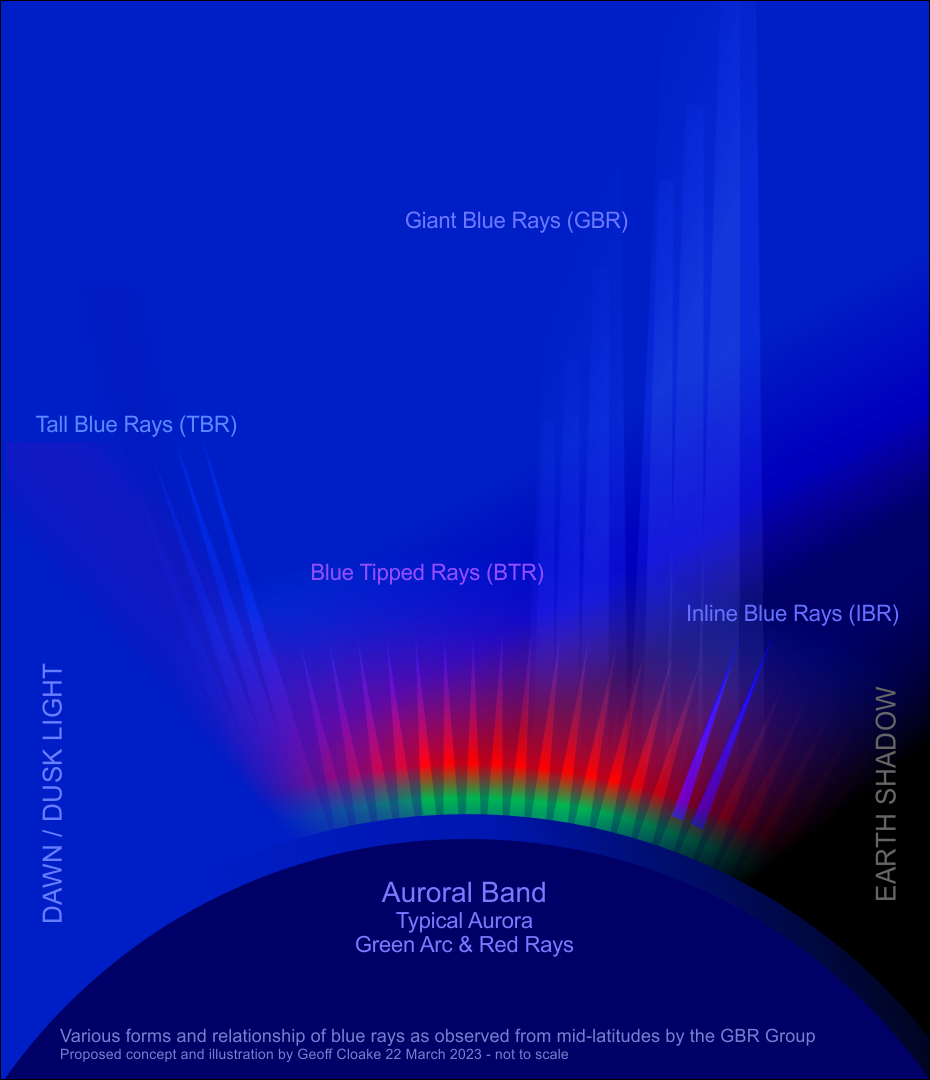
Blue light emissions have been observed in various forms and circumstances in the night sky and care is needed to distinguish GBRs. There appears to be little formal identification or classification of various blue rays so the following 'placeholder' names are proposed for the purposes of mid-latitude observations and GBR study. 'Aurora band' references the area of the aurora in the night sky where the aurora is usually observed and differs with latitude of observation..
Blue rays (under definition)
- Inline Blue Rays (IBRs) – appear within aurora band in the sky among of typical rays, or part thereof.
- Blue Top Rays (BTRs) - appear within aurora band as upper colour change in typical rays; especially at dawn or dusk; may also appear rearward, especially during summer.
- Tall Blue Ray (TBRs) – appear significantly above usual aurora band; either end especially at dawn or dusk; also more centrally, depending on viewpoint, and rearward, especially during summer; similar slenderness and tilt to typical rays.
- Giant Blue Rays (GBRs) – appear exceptionally high above aurora band; broader and more independently with varying tilt, mobile within pole-ward view; usually when aurora subsides.
Causation
Blue emissions are understood to be the effect of various gases present in the atmosphere and energetic particles from sunlight, solar wind, etc. Certain molecules and atoms absorb particle energy and re-emit it as light and heat. This can occur during both day and night processes, such as airglow or during solar wind storms, which create auroras. While nitrogen molecules (N2) are commonly associated with blue light emissions,
Oxygen, primarily known for producing green and red colors, can also emit blue light when its atoms recombine to form molecular oxygen (O2) during relaxation. Additionally, hydrogen and helium can contribute to blue light emissions, primarily through atomic processes and plasma discharges.
Gases are identified by variations in the color they emit. However it's important to note that SAR arcs, airglow, light scattering, etc.and even moonlight can influence the colors observed through the atmosphere,
Atmospheric gases are very rare where the GBR reaches raising questions about the cause of GBR light emissions, hence motivating this study.